The legend of KALO – KE – KAL – MAHAKAL
Bhasm Aarti and more
“Maha” translates to great and “kal’ translates to time, “Mahakal” literally translates to the one “greater than time” or “the lord who is above/controls time”. I was born and brought up in Indore, which is almost an hour away from Ujjain (the city of Mahakal). Till date, it is a tradition in our family to visit the Mahakaleshwar temple on birthdays, anniversaries or on purchase of land and assets. It is believed that Mahakal Bhagwan (or the Linga form of lord Shiva) can for see one’s bad time and a total devotee (sharnagat – the one who resides in lords’ feet) of the Linga would be saved from any evil eye or time trying to burden upon him. As one of the twelve Jyotirlingas, Mahakaleshwar Temple symbolizes the cosmic power and presence of Lord Shiva. Each Jyotirlinga is believed to have unique spiritual attributes and is associated with specific legends and miracles. Worshipping at Mahakaleshwar is believed to bestow spiritual merit and divine blessings upon devotees.
Legend of the Linga
Mahakaleshwar is one among the twelve major Jyotirlingas in India (situated in the state of Madhya Pradesh). The twelve Linga’s have a birth story. It is believed that when Shive appeared in the form of an infinite pillar of light, to settle the dispute of “greatest god” among Vishnu and Brahma. This pillar was extending to the three worlds (the earth, heaven and hell) and it is believed that on earth it appeared at twelves different places making them the Jyortilingas.
Some Hindus believe that the temple revolves around the concept of time and the cyclical nature of existence. It is said that Lord Shiva, in his form as Mahakal, presides over the cosmic cycle of creation, preservation, and destruction. He symbolizes the ultimate reality of existence, where everything eventually comes to an end to make way for new beginnings.
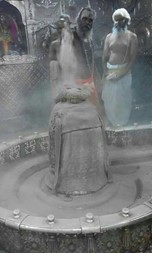
Image from Pinterest
Since the symbolic meaning of Mahakal depicts the end of every living being or even greater than one’s own life, the Bhasm aarti was started as a sincere devotion towards the Lord. There are people who confirm that the aarti happens to use fresh ashes from the dead, brought from the crematorium. Considering the belief that Shiva is considered at “Shamshan ke Sadhak” (meaning seeker of cremation ground) it is only fair to use the ashes. However most political leaders and priest resist this and say that the ashes come from cow dunk.
Click here to know more about Bhasm Aarti tradition/ritual
Beyond its religious significance, Mahakaleshwar Temple is also a cultural hub, showcasing intricate architecture, sculpture, and artistic craftsmanship. The temple complex comprises multiple shrines, halls, and courtyards, reflecting diverse architectural styles and historical influences.